Author: Blessing Olaoye

  • Introducing VectorLint: A Docs Audit & Monitoring Platform

    Introducing VectorLint: A Docs Audit & Monitoring Platform

    We are excited to announce VectorLint, a platform that automatically audits your documentation quality and gives you the ability to track improvements over time.

    Every great product experience starts with documentation that feels intentional and personal. It is clear, consistent, and genuinely helpful. But as more contributors get involved, maintaining that standard becomes increasingly difficult.

    Even with a style guide in place, contributors rarely consult it every time they write. They likely read it once and may not even remember to enforce everything as they work.

    This means every new page, contributor, and update is a chance for quality to slip without anyone realizing. Without a way to consistently enforce standards, these small drifts eventually lead to major documentation issues that could break customers’ trust

    This is why we built VectorLint.

    VectorLint applies your style guides and quality standards across every document, flags what needs attention, and tracks your quality score, showing how your documentation quality improves over time. You get enough information to connect your efforts to business outcomes and see exactly how your work moves the needle.

    Add Your Documents

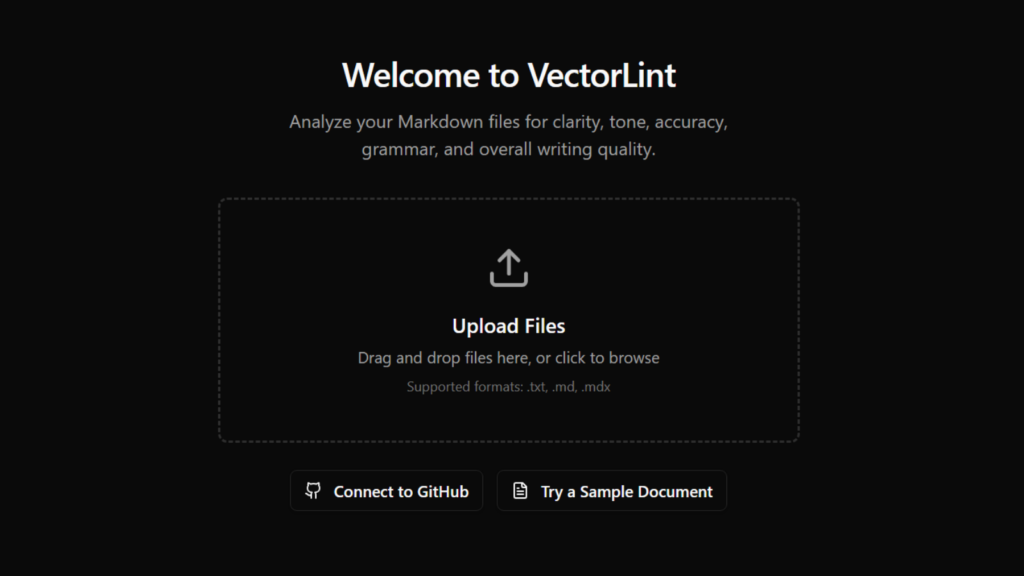
    Sign up and start adding your markdown files immediately. You can upload from your device, paste content directly, or drag and drop. VectorLint accepts .md, .mdx, and .txt files.

    Audit and Fix Issues

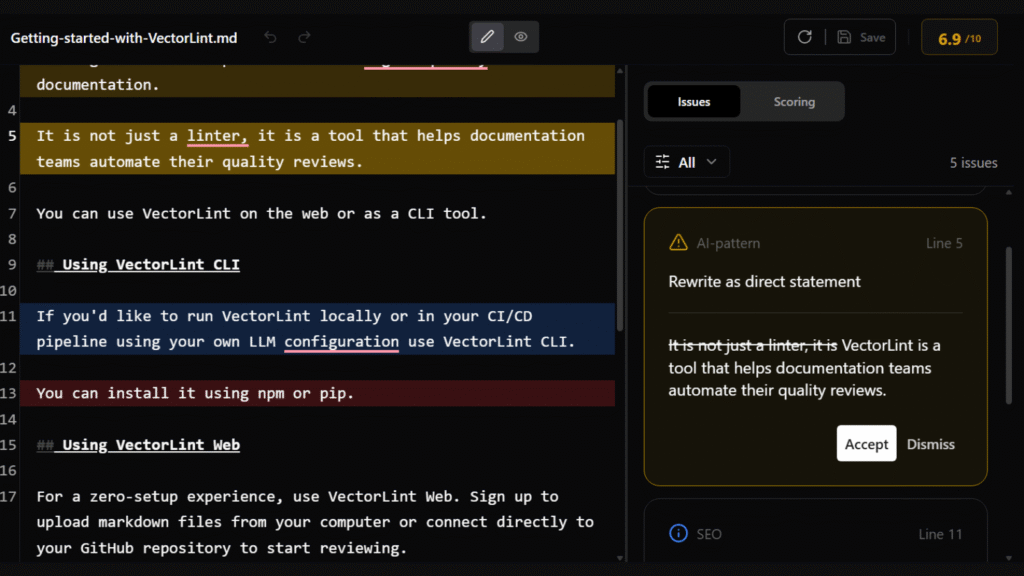
    Once you’ve added your files, you can run an audit, and VectorLint returns a quality score along with a detailed breakdown of every issue found. The breakdown includes the issue type (e.g., Readability, Accuracy), the severity level, the exact line it applies to, a clear explanation, and a suggested fix. You can accept or dismiss the suggestion.

    Rules

    VectorLint gives you full control over the quality checks applied to your documentation. Your rules are written in plain English. There is no regex, no config files, and no special syntax to learn.

    We’ve made it easy to define your standards using these three features:

    Style Instructions

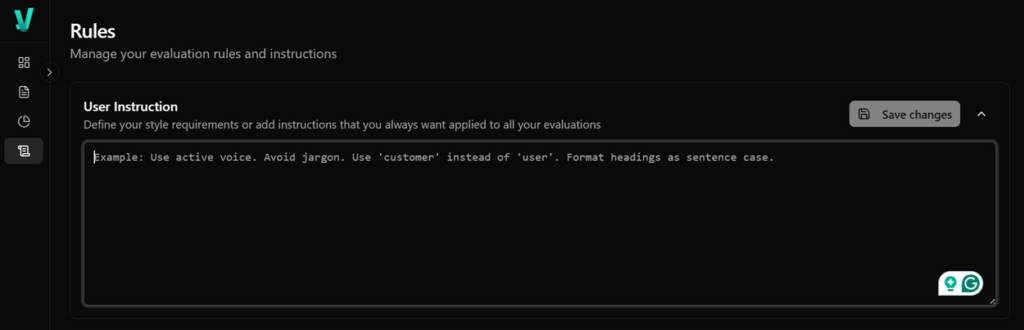
    Your style instructions are a set of requirements you want applied to every evaluation, across all your files. You can have your full style guide here, or just the key preferences you want consistently enforced.

    Built-in Rules

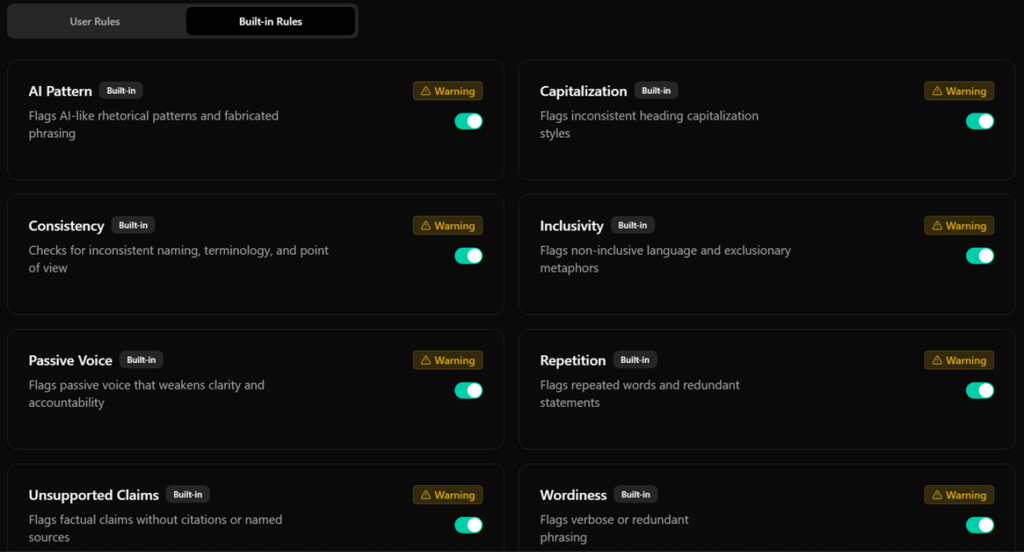
    VectorLint comes with preset rules targeting common documentation issues to get you started.

    User Rules

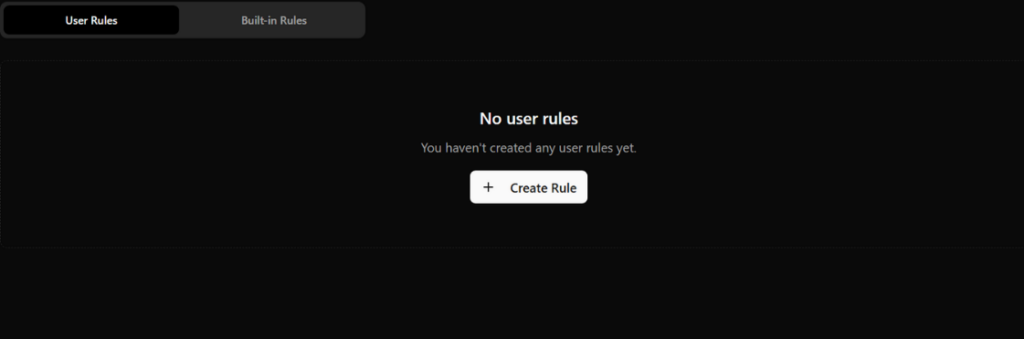
    You can add custom rules to enforce requirements specific to your team.

    Dashboard

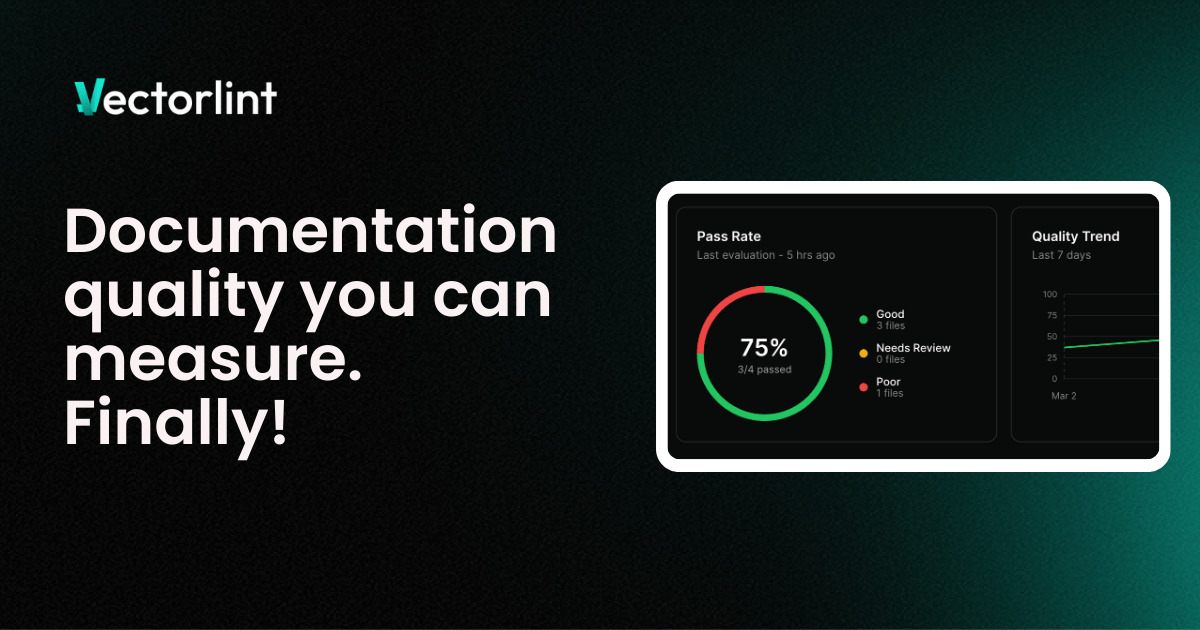
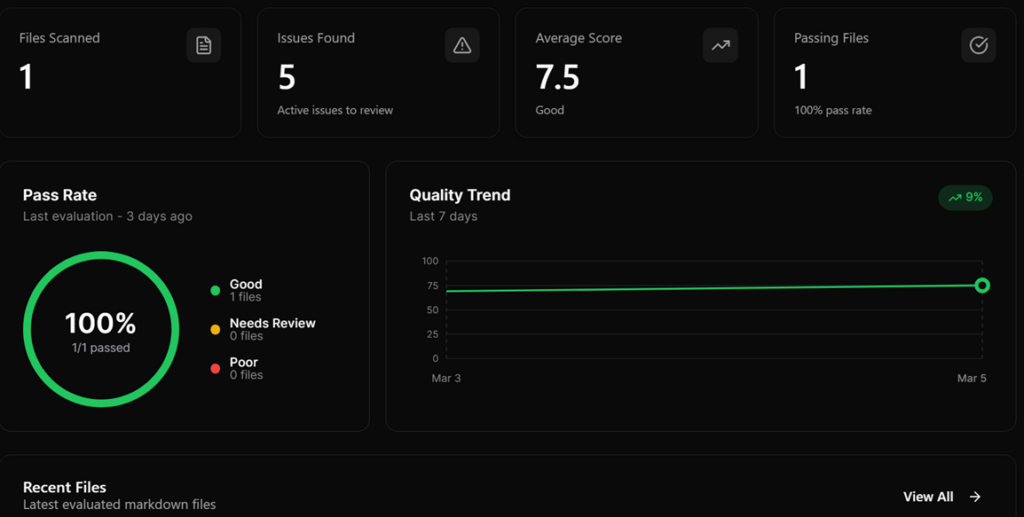
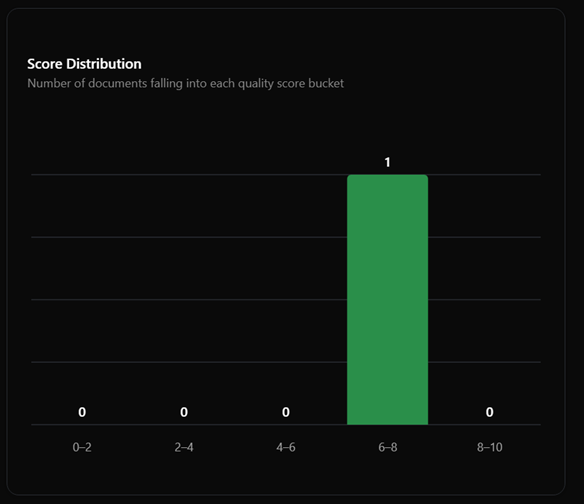
    The Dashboard shows your documentation health at a glance. You’ll see your pass rate, divided into Good, Needs Review, and Poor, and a quality trend chart tracking your progress over the last week.

    Quality Reports

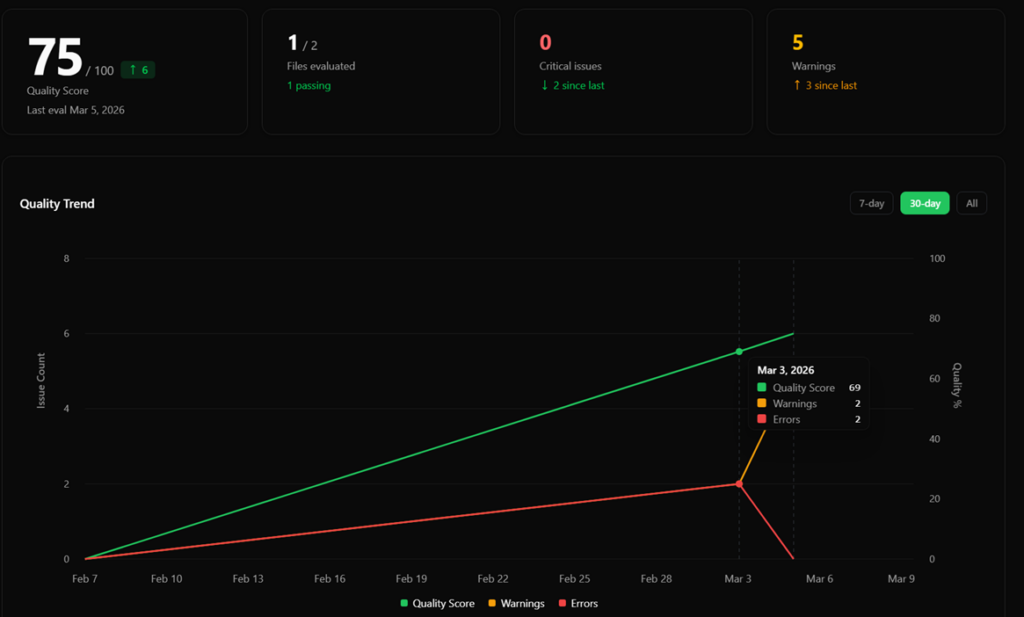
    The Reports page is where you’ll find the big picture. It shows your documentation quality trend over time, with detailed stats for your quality score, the number of files evaluated, and issue counts.

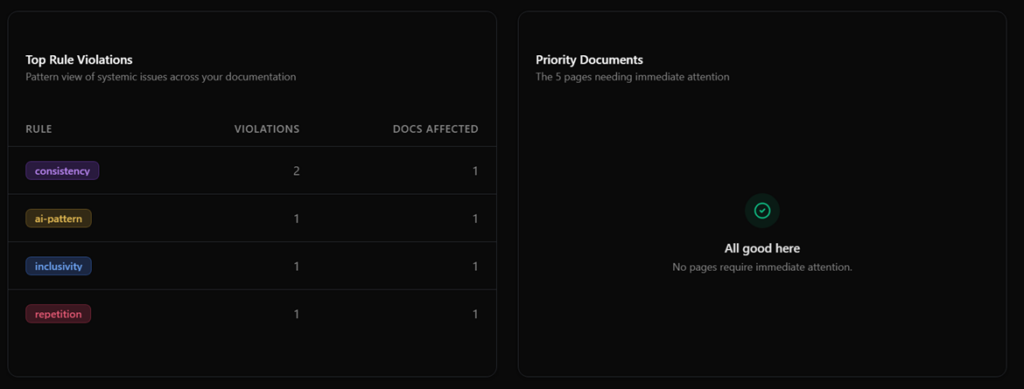
    You can also spot patterns with the Top Rule Violations table and see which pages need immediate attention in the Priority Documents list.

    What’s Coming Next?

    We’re shipping fast. Here’s what’s already in the pipeline:

    GitHub Integration — Connect your repositories and run quality audits automatically on every pull request. VectorLint will post results directly as PR comments and check runs. Your documentation gets reviewed alongside your code.

    Try It Today

    We built VectorLint because we believe documentation deserves the same automated quality standards as code. Sign up, add a file, and see your quality score in seconds.

    Get started now →

  • Review Checklist, Why You Need One

    Review Checklist, Why You Need One

    For technical startups, you need to publish quality content consistently for your developer audience to trust you. However, endless review cycle creates bottlenecks that slow down your entire content operation and make consistency nearly impossible to maintain.

    But what if you could integrate the review process into your workflow from the start? What if writers and reviewers were already on the same page, checking for the same things, before content even reaches the review stage?

    That’s exactly what a content review checklist does. It’s a simple tool that ensures every writer complies with your style guide even before submission, cutting down review cycles and maintaining consistent quality across all your content.

    In this article, you’ll learn what a content review checklist is, why you need one, and how to create one and use it in your workflow.

    What Is a Content Review Checklist?

    A content review checklist is a structured list of specific items used to evaluate each piece of content before publication. It turns writing and formatting standards into clear, actionable checkpoints that reviewers can verify one by one.

    While a style guide defines your overall writing and formatting standards, a checklist converts them into quick itemized checks for writers and reviewers, covering key elements such as grammar, tone, spelling, brand voice, formatting, and SEO considerations.

    In essence, a checklist gives your team a quick, simple, and repeatable way to ensure every piece of content meets set standards without missing critical details.

    Consistent Quality and Voice Across Content

    When multiple contributors are involved, each writer applies their own interpretation of quality standards. One contributor might prioritize technical accuracy while another focuses on readability, leading to your content feeling inconsistent and unprofessional.

    Your audience won’t know what to expect from you, and for technical startups this is especially damaging because trust and credibility drive user adoption.

    However, implementing a review checklist before publication solves this problem by providing a unified quality benchmark. Every piece of content, whether written by in-house writers or guest contributors, passes through the same checks.

    Faster, Smoother Reviews

    Review cycles are often the biggest bottleneck in technical content operations. Writers wait for feedback while reviewers catch new errors in each round, creating frustrating back-and-forth delays.

    A content review checklist eliminates much of that friction.Writers can self-check their content against established criteria before submission, catching issues before they get to the reviewer’s desk. As a result, review iterations drop, rework decreases, and teams ship content faster while maintaining quality.

    Easier Scaling and Onboarding

    As your content operations grow, maintaining content quality as you onboard new writers becomes more challenging. New contributors face a learning curve before they can adapt to your writing style and brand voice, which adds pressure on reviewers and slows content production.

    But with a review checklist, new contributors get a roadmap of what “good” looks like and produce publishable content faster with less supervision. Hence, your checklist serves as a built-in training resource that lets you scale your content program without sacrificing consistency or burning out reviewers.

    Creating a Checklist from Your Style Guide

    If you already have a style guide, you can quickly convert it into an actionable checklist using this ChatGPT prompt:

    You are a content operations expert tasked with converting a style guide into a practical, actionable review checklist. Your goal is to transform style guide principles into specific, checkable items that writers can use for self-review and reviewers can use for quality verification.
    
    **Your Task:** Analyze the provided style guide and create a comprehensive content review checklist that ensures consistent quality, voice, and brand compliance across all content.
    
    **Input:** [Paste your complete style guide here]
    
    **Checklist Reqirement:**
    
    1. **Structure the checklist into clear categories** such as:
        - Brand Voice & Tone
        - Technical Accuracy
        - Formatting & Structure
        - SEO & Optimization
        - Grammar & Language
        - Visual Elements
        - Compliance & Legal
    2. **Make each item actionable and specific** - avoid vague statements like "check tone" and instead use specific criteria like "Does the content use active voice in at least 80% of sentences?"
    3. **Include binary yes/no checks** where possible, making it easy to verify compliance
    4. **Add brief explanations** for complex items that might need clarification
    5. **Prioritize items** by marking critical must-haves vs. nice-to-haves
    6. **Make it scalable** - suitable for both new contributors and experienced writers
    7. **Keep it practical** - aim for a checklist that takes 10-15 minutes to complete
    
    **Desired Output Format:**
    
    - Organized by category with clear headings
    - Checkbox format for easy use
    - Brief explanations where needed
    - Estimated time to complete each section
    - Priority levels (Critical/Important/Optional)
    
    **Additional Context:** This checklist will be used by [describe your team size, content types, and frequency]. The goal is to reduce review cycles, maintain consistency, and help new contributors produce publishable content faster.```
    

    Using Your Checklist

    The usual way to implement a checklist is for writers and reviewers to systematically work through each item, marking it complete before submission and publication.

    This approach helps prevent oversights and reduces unnecessary back-and-forth. However, manual checking is time-consuming, and under deadline pressure, it’s easy to skip items or rush through them.

    To reduce this burden, some teams try to automate the process with AI. They provide the content and checklist to tools like ChatGPT and ask it to evaluate each item.

    ChatGPT flags issues that need attention, which speeds up the review process compared to manual checking.

    But this approach has its limitations. You’re still manually copying and pasting content for every single piece, which creates friction and takes time. There’s no workflow integration, so it’s easy to skip this step entirely when deadlines are tight.

    Then there’s the consistency issue with generative AI models. The same content can receive different feedback across runs.

    Generative AI models may also miss nuanced issues a human would catch, or hallucinate problems that do not exist.

    Your Checklist, On Autopilot with VectorLint

    Instead of manually running checks, what if your checklist ran automatically on every content submission? That’s where VectorLint comes in.

    VectorLint is an LLM-powered prose linter that automates content quality checks. Think of it like Vale, but for content quality issues that require understanding context not just pattern matching, such as weak headlines, AI-generated writing patterns, unclear value propositions, etc.

    How VectorLint Works

    Convert your review checklist into automated rules that run in your CI/CD pipeline. Define checklist items as evaluation rules in simple Markdown files using natural language, then configure which rules apply to which content types.

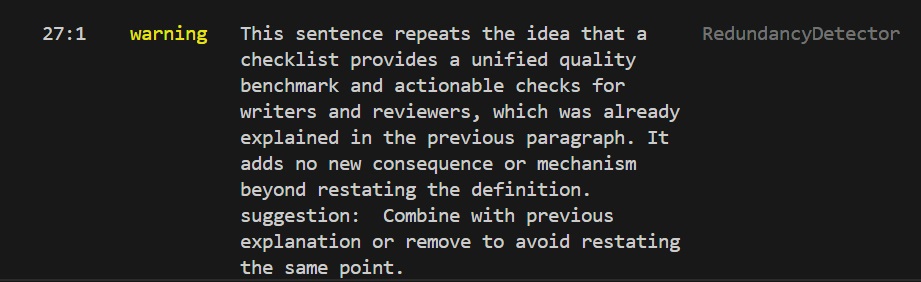
    For example, if your checklist includes “Avoid unnecessary repetition that doesn’t add value,” you can create a VectorLint rule that detects redundant phrases and explanations. The rule flags content where points are repeated without adding new information.

    VectorLint flagging redundant phrasing in an earlier draft of this article

    VectorLint runs automatically on every content submission via pull requests, commits, or any CI/CD trigger you configure. Content that doesn’t meet your standards gets blocked before reaching human reviewers, just like a failing test blocks a code merge.

    This way, writers get immediate, consistent feedback and quality standards are enforced uniformly across all contributors.

    VectorLint is open source and built by TinyRocket to help technical teams ship quality content faster. Need help with setup or custom rules? We’ll get you up and running.

  • The Easiest Way to Maintain Doc Quality With Several Contributors

    The Easiest Way to Maintain Doc Quality With Several Contributors

    Maintaining documentation quality is challenging when multiple contributors are involved. Each contributor brings their own writing habits, and small inconsistencies start to build up across the docs.

    Over time, this work shifts to editors. They spend hours each week fixing the same basic issues like terminology inconsistencies, formatting problems, and style mismatches which slows down updates.

    Editors spend significant time fixing style mismatches, causing documentation to lag behind active development.

    This article will show you how your team can maintain consistent documentation quality with multiple contributors, without burning hours and mental energy.

    What is Even Documentation Quality?

    Quality documentation gives readers what they want and expect. When developers and technical users come to your docs, they have expectations shaped by their goals and past experiences with technical documentation that works.

    Industry surveys reveal six fundamental expectations that define doc quality:

    1. Technical accuracy and completeness

    This criterion tops every list because readers expect your documentation to accurately reflect how the product works, including prerequisites, limitations, and edge cases.

    When they follow your instructions and encounter errors due to inaccurate or incomplete information, it makes them lose confidence in your product.

    2. Up-to-date and maintained content

    Your documentation should evolve with your product, staying current with new features, updated APIs, and best practices.

    Outdated instructions, broken links, or screenshots showing an outdated UI not only waste readers’ time but also signal neglect, which erodes trust and confidence in your product.

    3. Practical examples and guidance

    Simply describing features without context is not enough to show developers how to use your tool. They need to understand how those features fit into real workflows and how to troubleshoot errors when they don’t behave as expected.

    Developers find it helpful to have common use cases, integration patterns with popular tools, and clear troubleshooting flows for known issues.

    4. Clear structure and findability

    Developers are often under tight deadlines and need to find answers quickly without having to read through the entire piece of content.

    Hence, your docs should prioritize speed to value by following a consistent, logical structure with headings that reflect common tasks or user intent.

    For example, “How do I migrate from X?” or “Integrating with Y,” rather than just listing features. Effective search and predictable organization help users locate information efficiently and get back to work faster.

    5. Consistent terminology

    When one article uses “API key” and another uses “access token” for the same concept, readers have to stop and verify whether these are different things, interrupting their workflow and causing unnecessary cognitive load.

    They expect to learn your system’s vocabulary once and apply it everywhere. Inconsistent terminology signals a lack of coordination and erodes trust in the documentation’s reliability.

    6. Clarity and conciseness

    The goal is to help your readers quickly understand and apply information. Hence, your documentation should use clear, simple language, and explain technical jargon when first introduced.

    Sentences should be direct, instructions actionable, and content free of unnecessary repetition.

    Where Doc Quality Problems Appear with Several Contributors

    Documentation quality issues often appear in environments like the ones below.

    Open Source Projects with Community Contributors

    Open source projects often receive documentation contributions from people with diverse backgrounds.

    They bring different writing styles, spelling conventions, formatting preferences, and terminology choices that usually do not align with your project’s preferred style.

    When you receive several open-source documentation PRs each month, correcting terminology, formatting, and style in each one can take hours. Furthermore, errors slip through when maintainers are overwhelmed.

    Engineering Teams with One Technical Writer

    Some teams have one technical writing expert maintaining the documentation contributions from dozens of engineers.

    These engineers are engineers first and writers second, so their writing skills vary. And because documentation isn’t their primary work, they don’t have the time to master style guides and writing conventions, which inevitably leads to quality issues.

    This puts a heavy load on the technical writer. As contributions stack up, they spend days correcting basic style violations, inconsistent terminology, improper heading hierarchy, and tone mismatches before they can even assess whether the technical content is accurate.

    Meanwhile, engineers wait days for feedback on their contributions. In high-velocity teams shipping features weekly, documentation falls behind because the writer can’t keep pace with the volume of corrections.

    Existing Solutions

    Manual Review

    Many editors have a checklist of quality checks to review, usually including passive voice, terminology, heading hierarchy, code formatting, and technical accuracy. The process usually involves reading through content multiple times, focusing on different aspects each pass.

    This method works because it allows the reviewer to concentrate on the most critical quality issues. However, it becomes unsustainable when there are large volumes of contributions from multiple writers.

    Manual review is time-consuming and mentally exhausting, and as fatigue sets in, even experienced editors may miss errors or inconsistencies despite their best efforts.

    Prose linters (Vale, Markdownlint)

    Prose linters are automated tools that scan writing for style and formatting issues based on predefined rules. They help teams catch problems early and enforce consistency across documentation.

    Vale is the most popular prose linter. It automates style checks using configurable rules, catching terminology mistakes, formatting issues, and other objective errors. Markdownlint focuses on structural checks, such as heading hierarchy, spacing, and list formatting.

    These tools are genuinely useful because once the rules are set up, they apply them automatically to every contribution, removing a lot of repetitive manual checking.

    However, getting Vale running well takes significant configuration effort. Teams often spend weeks defining rules, and that upfront work becomes a barrier to adoption.

    As documentation grows, the maintenance burden also increases. Edge cases show up, rules need refinement, and false positives appear when valid writing gets flagged because the tool can’t interpret context.

    In addition, proselinters only catch objective issues, such as consistency in terminology and formatting. Subjective areas that require contextual understanding, such as clarity, tone, explanation quality, and technical accuracy, are left for human review, which takes time.

    LLM + Checklists

    LLMs understand context in ways rule-based proselinters can’t. For example, they can tell when passive voice is acceptable in a technical explanation and when active voice would make a tutorial clearer.

    As a result, many teams pair LLMs with their existing checklists. They paste content into ChatGPT, include the checklist, and ask it to review the writing.

    However, this approach is a naive use of LLMs. Their output isn’t consistent, and you can’t reliably predict or reproduce the results.

    The same prompt can generate different responses across runs, and without structured prompting and controlled settings, the feedback varies widely. As a result, LLMs often miss important quality issues.

    A Better Way to Do Things

    Although these existing quality tools save time, they still leave quality gaps. Rule-based tools miss issues that require contextual understanding, while basic LLM use is inconsistent and unpredictable. You need a system that combines automation with intelligent judgment.

    VectorLint fills this gap. It’s an LLM-powered prose linter that evaluates subjective qualities like clarity, tone, and technical accuracy, nuances that regex rules miss.

    By using structured rubrics at low temperatures, VectorLint provides consistent, actionable feedback that addresses LLMs’ unpredictability.

    Setup is simple: describe your standards in natural language, and VectorLint enforces them in your CI/CD pipeline.

    Think of it as a complementary system to Vale. Use Vale for the rigid objective rules, and VectorLint for the intelligent subjective review. This combination saves editors even more work hours to focus on strategy instead of style policing.

    At TinyRocket, we built VectorLint to solve this exact problem. We work with teams to define quality standards and implement tailored docs-as-code workflows that specifically fit their needs.

    Book a call to discuss your documentation quality challenges.