Blog

  • How We Screened 124 Writer Applications in 4 Hours

    How We Screened 124 Writer Applications in 4 Hours

    AI search is fast becoming the primary way people find information, and one of the criteria for your content to get cited is that it offers unique insights.

    So, as a startup looking to scale its technical content strategy, you need writers who both have a strong grasp of their domain and can write well. They should have interesting insights or takes to share. However, these writers are challenging to find.

    You might have hundreds of applicants for a single job posting, but only a few will have the skills you need. With AI making it easy to create content, you also get a flood of applications.

    Reviewing them takes a lot of time you don’t have, but you also can’t ignore them because among those applications are writers who could bring the value you need to scale your technical content strategy. So what do you do?

    Well, to solve this problem for our client, we built an automated screening system that reduced what could have been weeks of manual review to just four hours.

    The Problem

    Finding Contributors With Real Authority in a Crowded Market

    Our client runs a community writing program and received 124 applications with over 300 articles to review.

    It might not seem like much, but they were a small team, and manually reviewing them would have stretched into weeks. Not to mention the oversights on qualified candidates that could occur if fatigue sets in.

    The goal was clear: quickly identify contributors from a relatively large pool of applicants who could share insights beyond the basics and communicate them well.

    Here’s how we solved the problem by engineering an evaluation prompt and integrating it into their application flow.

    The Solution

    We solved the problem in four steps.

    1. Defining content criteria
    2. Gathering data
    3. Prompt engineering
    4. Integration

    Step 1: Defining Content Criteria

    Our client wanted writers who could share insights from their experience and write with authority.

    So, we broke down the authority criteria into three types: experiential authority, research-based authority, and implementation authority.

    Experiential Authority: Identifies writers who have actually implemented what they discuss, shown through specific scenarios and lessons learned.

    Research-Based Authority: Separates writers who understand the broader context from those rehashing basic concepts.

    Implementation Authority: Distinguishes between those who have built real systems versus those who have only read about them.

    After deciding on the criteria, we set out to create a dataset of articles, a list of the kind of articles that met our standards, and those that didn’t. This would teach our evaluation system what “good” and “bad” looked like.

    Step 2: Gathering Data

    To ensure our AI system could accurately identify these authority types, we needed concrete examples of what good and bad articles looked like.

    We manually sorted through existing articles to create a dataset of clear examples that demonstrated strong authority versus those that appeared knowledgeable but lacked real expertise.

    Our goal was to produce reliable evaluations. Without these examples, our prompts would be theoretical guidelines that the AI couldn’t reliably apply. The AI model required reference points to comprehend subjective concepts such as “authority” and “expertise.”

    The manual sorting process also helped us identify subtle patterns that distinguished truly authoritative content from surface-level knowledge.

    Step 3: Prompt Engineering and Testing

    Based on our defined criteria, we created a rubric and prompt that included concrete examples of what constituted strong versus weak authority indicators.

    For instance, strong experiential authority was characterized by articles that included specific tools used, problems encountered, and solutions implemented, whereas weak authority meant generic advice without personal context.

    We created disqualification criteria that would automatically filter out basic tutorial content and articles lacking practical experience indicators. The rubric provided clear scoring guidelines, allowing the AI model to evaluate the content with consistent assessment.

    We deliberately started with a lenient rubric to avoid false negatives, so we wouldn’t miss qualified candidates, and then tuned it when we observed unqualified articles passing the assessment.

    Step 4: Integration

    We built the automation workflow using n8n, integrating it with Google Forms, which they used to accept applications.

    When a new application was submitted, the workflow evaluated the author’s submitted articles and sent the assessment to the content team via Slack. The justification behind each assessment was included, so the team could validate the reasoning.

    The Result

    We completed all 124 application screenings in 4 hours versus the 3–4 days manual review would have required. And out of 124 applications, only 4 candidates met our authority standards.

    Imagine if the client reviewed all 124 manually, only to get 4 candidates. The automated screening system also revealed that inbound applications weren’t the best source of quality contributors, validating a shift toward outbound recruitment.

    Instead of spending days reviewing unsuitable applications, our client could invest that time in reaching out and building relationships with writers more likely to meet the publication’s requirements.

    TinyRocket – Content Compliance Partner

    Onboarding authors is just one part of executing a technical content strategy.

    After onboarding, you’ll need to manage and review the content to ensure it meets your quality standards. This takes time that could be spent on distribution, making sure your content reaches your target audience.

    That’s why we help technical startups build content compliance systems that integrate into their existing workflows so they never have to worry about quality.

    If you’d like to scale your technical content strategy without increasing overhead, book a call, let’s have a chat.

    Frequently Asked Questions

    1. Could we have just used ChatGPT directly instead of building a custom system?

    Using ChatGPT to review each article based on the client’s criteria might sound like a solution, but it would still be slow and unreliable. We would have had to paste each of 372 articles across 124 applications individually, which would have taken hours.

    The bigger issue is consistency. ChatGPT’s context window expands as you add more content, and it becomes less reliable at following specific requirements. By the time dozens of articles have been processed, it may have lost the thread of the instructions and the results would no longer be reliable.

    2. How do you ensure the automated system doesn’t miss qualified candidates that a human would catch?

    Our three-authority evaluation criteria were designed based on extensive analysis of what distinguishes good candidates from poor ones. Rather than trying to identify everything we wanted (which is subjective), we focused on clear indicators of real expertise versus theoretical knowledge.

    Processing individual articles with consistent rubrics ensures our evaluation criteria don’t drift over time like manual review does. In addition, our iterative refinement process helped us handle edge cases systematically.

    3. Can this approach work for other types of hiring beyond content creators?

    Yes. The same approach, defining clear authority signals, building an example dataset, creating a rubric, and integrating the evaluation into your intake workflow, can be adapted to other roles where demonstrated experience matters.

  • How TestingPod Cut Down its Content Review time by 50% with TinyRocket

    How TestingPod Cut Down its Content Review time by 50% with TinyRocket

    TestingPod is a software testing publication operated by MagicPod, a no-code test automation platform. The publication features paid contributions from experienced software testers as part of an effort to build a software testing community and establish trust with its target audience.

    The Challenges

    TestingPod ran its community writing program with a single editor managing roughly 20 contributors. Because most writers were software testers first and writers second, the content required significant editorial work before it was ready to publish.

    To consistently publish quality content with a one-man editorial team, they needed to overcome these challenges:

    • No editorial standards: The publication had no style guide, contribution guidelines, or process documentation. Writers had no reference for what “publish-ready” looked like.
    • Voice vs. standards: The editor had to enforce brand quality standards without silencing each contributor’s authentic voice.
    • Slow review cycles: Each article took roughly four hours to review. Contributors would often take days to respond to feedback, stalling the publication process.
    • Feedback bottleneck: Crafting clear, constructive feedback took far longer than identifying issues. Even when contributors took days to apply the feedback, they would often introduce new errors, triggering a repeat of the entire cycle.
    • Platform friction: Content was managed through HubSpot. With one editor managing 20 writers, TestingPod needed automation to scale, but HubSpot wasn’t built for multi-author workflows and offered limited automation capabilities.

    Our approach

    Workflow audit and prioritization

    We started by timing the editorial workflow to identify where time was being lost. The data showed that crafting feedback, not finding issues, consumed the majority of review time. Hence, we prioritized solutions by impact and implemented them incrementally.

    Content management migration

    To support a multi-author workflow, we moved content management from HubSpot to GitHub, which provided:

    • Centralized documentation: Articles, style guides, and contribution guidelines were moved into a single, accessible repository.
    • Familiar tooling: Most writers were technical professionals, so GitHub was a familiar environment.
    • Process transparency: Writers had full visibility into the history of submissions and editorial feedback across their work, allowing them to learn from past reviews.
    • Automation infrastructure: GitHub provided the necessary foundation to integrate automated review tools directly into the submission process.

    Editorial standards and process documentation

    We identified recurring quality issues and helped establish the editorial standards and processes that TestingPod was missing, including:

    • A comprehensive style guide and contribution guidelines: These documents define the brand’s quality standards, tone, and publication conventions, and set clear editorial expectations for writers before they start drafting.

    As we spotted new issues, we documented them and refined these documents over time.

    AI-assisted feedback workflows

    We built an AI skill that addressed the feedback bottleneck with:

    Rough-to-clear feedback conversion: It translates rough editorial notes into polished, constructive feedback. The editor could input brief, blunt notes like “this section isn’t clear,” and the AI would convert them into complete, professional guidance.

    Consistent tone: The system ensured feedback remained constructive and encouraging across all interactions.

    Voice preservation: The system helped the editor balance strict quality enforcement with the preservation of each writer’s authentic voice.

    Automated content review with Vale

    With GitHub as our hub, we integrated Vale to automatically catch recurring issues such as colloquial language, low- and high-level redundancy, and other stylistic inconsistencies at the Pull Request level.

    We also added structural rules to limit Markdown headings to H1–H3 to keep articles scannable and to enforce consistent capitalization.

    Writers received this automated feedback the moment they submitted their work, allowing them to self-correct surface-level issues before the editor opened the file.

    The Outcome

    The combination of AI-assisted feedback and automated content review produced immediate results:

    50% reduction in review time: Articles that previously took four hours to review now took two.

    Recurring issues were caught automatically: Quality issues that often led to back-and-forth review cycles were flagged and fixed before reaching the editor.

    Transparent editorial process: Writers learned from previous feedback, improving submission quality over time.

    Editor freed for high-value work: With surface-level issues handled automatically, the editor could focus on structure, argument quality, and voice refinement.

    The content engineering system enabled TestingPod to maintain a cost-effective, community-driven content program without sacrificing quality or contributor voice.

  • How TestingPod Is Scaling Its Community Writing Program with Automated Content Compliance

    How TestingPod Is Scaling Its Community Writing Program with Automated Content Compliance

    TestingPod faced the challenge of publishing quality content with a team of freelance writers from the software testing community.

    They wanted to keep the content team small, because the blog was initially their way of giving back to the software testing community. By offering paid writing contributions, anyone could share unique insights on a any software testing topic and get paid.

    Although they’ve been able to filter out low-effort AI-written submissions, they still face the challenge of reviewing and editing content from the community, as most people were testers first and writers second.

    Meaning they had interesting insights to share, but their content required significant edits to be publish-ready. We knew the only way to grow the publication with a small team was if we used AI, which brought us to creating AI assistants.

    Creating Claude Assistants

    To start getting results immediately, we created AI assistants or projects in Claude that could help us complete different review activities quickly.

    For instance, one assistant we created was a feedback assistant that turned any rough feedback on an article into clear and constructive feedback for the authors. This meant that the team didn’t need to spend time crafting feedback as they reviewed content.

    The assistant saved the team time. However, it still wasn’t autonomous. It still required significant oversight from the team, and it still wasn’t reaching the scale we wanted TestingPod to reach.

    We believed that to truly scale TestingPod and still make it cost-effective to run, we had to create a truly autonomous system where writers would get instant feedback, reducing the errors that would get to the editors.

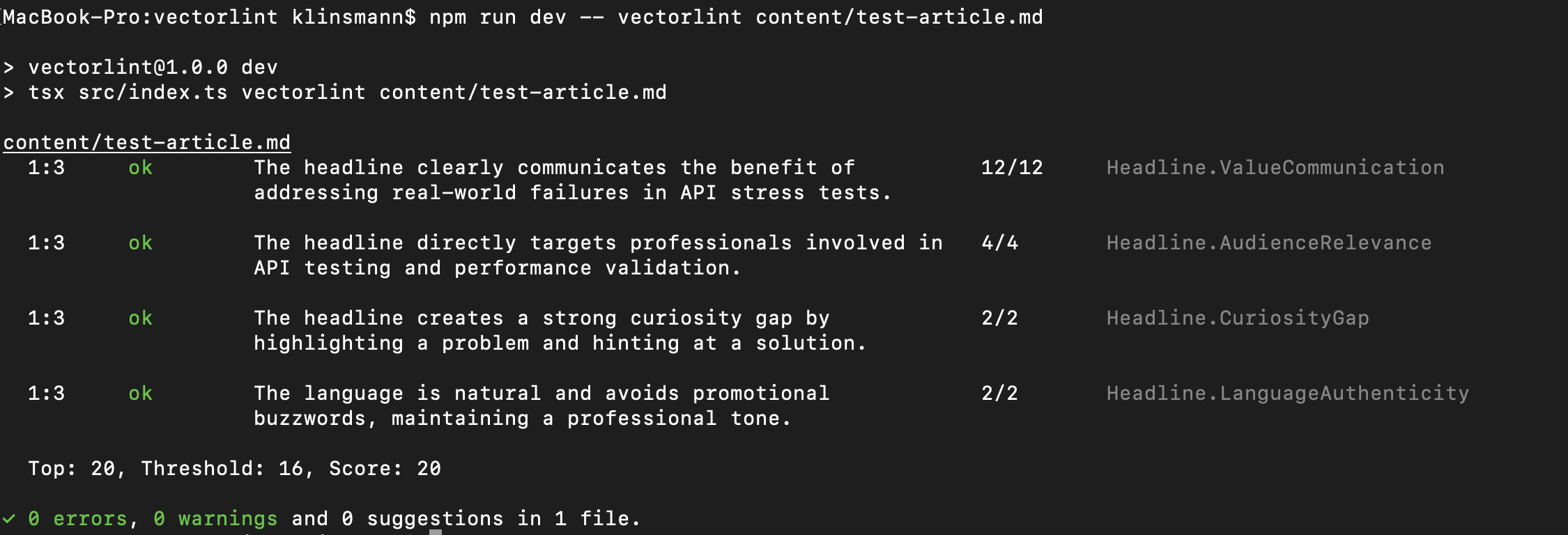
    This led us to build VectorLint, a command-line tool that guides writers towards their desired quality standards through AI-automated evaluations.

    VectorLint CLI Tool

    VectorLint is a command-line tool that runs content against carefully engineered content evaluation prompts.

    It provides a score to its user as well as suggestions, enabling them to adjust their content to meet an acceptable quality standard or score.

    As a command-line tool, it means it can be run in a CI/CD pipeline in GitHub, meaning that writers can get instant feedback on their content whenever they submit their articles. Instead of submitting drafts and waiting days for feedback, they get instant evaluation against TestingPod’s specific standards.

    It could also be run locally, enabling writers to fix issues before submission.

    What This Means For TestingPod

    For TestingPod, this means they can scale their technical content strategy without increasing team overhead.

    VectorLint makes it possible for a small team to maintain consistent quality standards across all contributors. Just turn style guides into evaluation prompts, and every contributor gets consistent feedback on their content.

    And with fewer issues getting to the content team, it frees them up to focus on other priorities like distribution and community engagement.

    Automated quality compliance ensures that every piece of content meets TestingPod’s standards, regardless of who wrote it.

    The Vision: Giving Any Tester The Platform to Share Their Voice.

    Our ongoing goal is to expand the evaluation prompt library continuously.

    As the content team identifies new issues during reviews, we capture them and convert them into automated evaluation prompts. Over time, this creates a completely autonomous review system that enables anyone with valuable testing insights to share their knowledge, regardless of their writing ability.

    TestingPod will truly become the hub where testers can share their unique experiences.