The term content engineer means different things depending on who is hiring.
If you have encountered the term in job postings, community discussions, or vendor content and wondered how it differs from technical writing, you aren’t alone. Many technical writers already do much of what companies describe when hiring content engineers, so the roles can appear to overlap.
That raises a reasonable question. Is content engineering a new name for technical writing, or does it describe a genuinely different role?
This article compares the two based on how companies define content engineering in job postings. It examines what each role does, what employers expect, where they overlap, and whether technical writing has ever fully captured the work the role has required.
By the end, you’ll have a clearer line between what each role produces, where they overlap, why the distinction matters, and who you should hire based on your company’s structure and needs.
First, here are some common misconceptions about content engineering.
Misconceptions about Content Engineering
These are three common ways people define content engineering or describe what the role involves:
- A content engineer is an engineer who writes content. The definition is technically accurate in the same way “a software engineer is someone who writes software” is accurate, but it doesn’t tell you what the person actually does.
By that definition, a mechanical or electrical engineer who writes installation manuals is also a content engineer. The description fits so broadly that it creates confusion about what the person does.
If a software engineer does software engineering, then a content engineer should do content engineering.
- Content engineering is a new name for technical writing. Companies have repeatedly renamed technical writing as a discipline. Titles like content developer, information developer, and knowledge engineer have appeared, and each time the scope stayed the same while only the name changed.
Mark Baker, author of Every Page is Page One, noted as far back as 2013 that “the constant and uniformly unsuccessful attempts to rename technical writing left many in the field hypersensitive” to yet another name for the same work.
Many technical writers look at what people describe as the requirements for a content engineer and see things they already do, so the obvious conclusion is that the new role is another name. However, it raises the question of whether technical writing was ever a complete title for the role.
- Content engineering is about scaling content production. This is more common within the search marketing and B2B SaaS industry. Some vendors such as AirOps and another content marketing vendor define content engineering exclusively as building AI production pipelines for scaling content.
In the developer tool space, content goes beyond blog posts. It also includes documentation. Content engineering could involve building drift detection systems, quality gates, review automation, and maintenance workflows.
That work has nothing to do with producing more marketing pages.
What a Technical Writer Does
A technical writer’s primary output is content, including API documentation, integration guides, SDK references, tutorials, release notes, and changelogs.
They research the product, talk to engineers, test the software themselves, and translate that understanding into content that developers can use.
Beyond producing new content, technical writers maintain what already exists. When they spot inaccuracies or style issues in shipped content, they update the affected pages. When the product ships a new version, they revise the docs to match. This ongoing maintenance work is a significant part of the role and often takes more time than writing new material.
Technical writers work within content systems. They open pull requests, follow the review process, and publish through the Docs as Code pipeline. The pipeline itself, however, isn’t their core responsibility. They operate inside the workflow rather than building or maintaining it.
That said, the industry has been shifting. As companies adopted Docs as Code workflows, roles like documentation engineer emerged. These were people who owned the system for producing and maintaining documentation, rather than the content alone. Some technical writers moved into that work, a shift that predates the current content engineering conversation.
What a Content Engineer Does
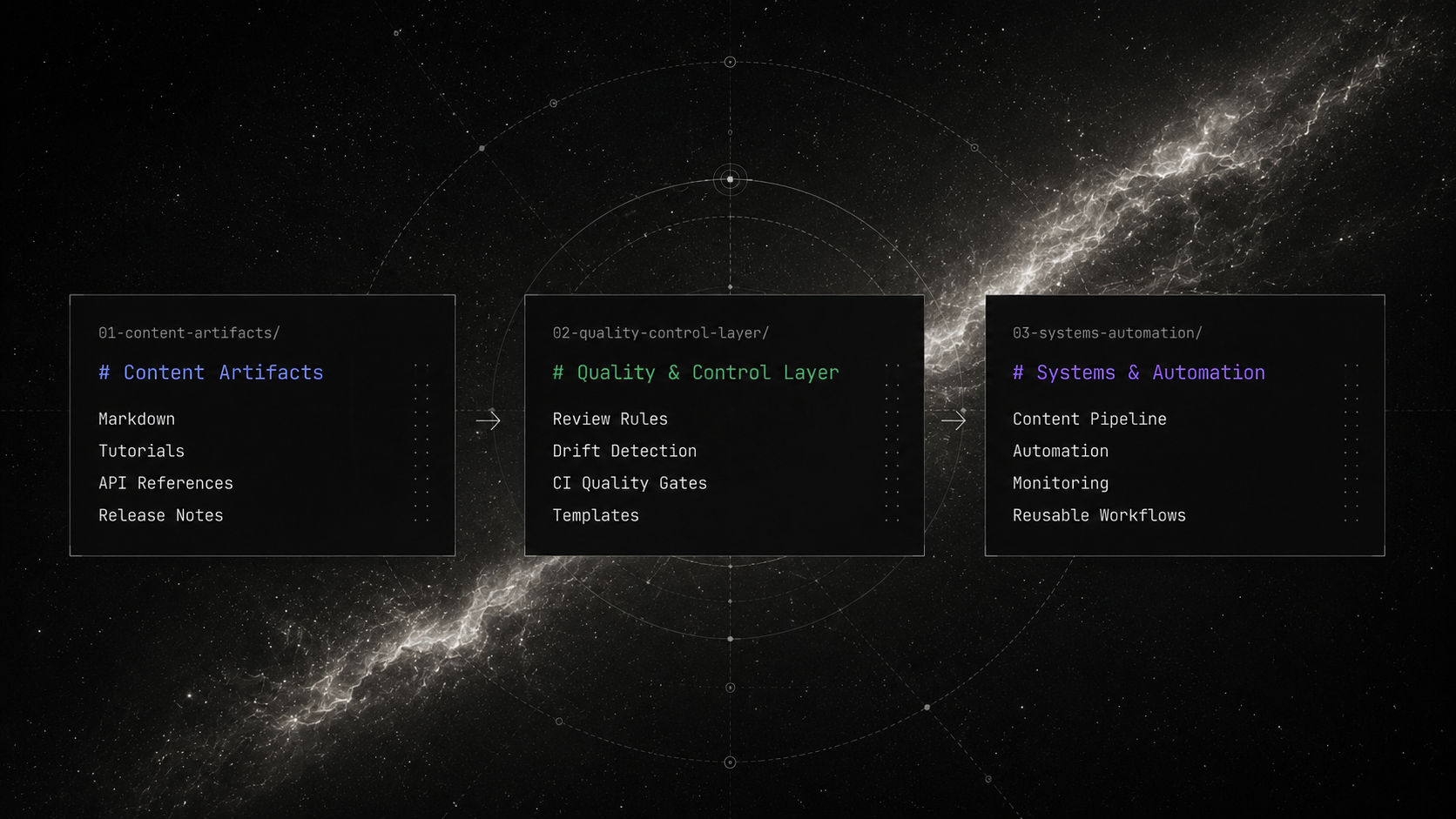
A content engineer’s primary output is systems, not content. They build the infrastructure that content moves through, including pipelines, automation, quality gates, and workflows.
Their work can involve building documentation systems, including drift detection that flags outdated docs when product code changes, prose linters, automated reviews in CI, maintenance workflows, and reusable templates that reduce effort per update. This is documentation engineering work.
However, content engineering also covers marketing content systems, including production workflows, quality enforcement, topic research workflows, and maintenance automation that keep published blog posts and guides aligned with the product as it evolves.
While documentation engineering covers docs infrastructure, content engineering extends that work to marketing systems as well.
The Overlap and Difference
Content engineers and technical writers share the same content environment, tooling, and quality concerns.
Both roles use the same publishing environment, review process, and quality standards, which is why the distinction can feel blurry, especially in small teams where the same person may write content, maintain workflows, and improve the tooling around publication.
If the primary responsibility is producing content, that’s technical writing. If the primary responsibility is building and maintaining the systems that content moves through, that’s content engineering.
A technical writer improves the content inside the workflow. A content engineer improves the workflow itself, including the review rules, automation, quality gates, publishing process, and maintenance systems around the content.
For practitioners who were already building pipelines, configuring automation, and designing workflows alongside their writing, “technical writer” was never the most accurate description of the full scope.
Content engineering names that systems work more precisely.
Deciding Who to Hire
A technical writer’s job is as valuable as ever. The question is which role gets you to your goal faster, given your team’s structure.
For teams with significant content volume, building systems that produce and maintain content delivers more leverage than managing each piece manually.
If you already have a technical writer who’s been building tooling and automation alongside their content work, you could formalize that as their primary responsibility. They already understand the content, and now they’ll own the infrastructure as well.
If the systems work is complex enough and your writer’s time is better spent on content, hiring a dedicated content engineer is the better move. That way, your writer isn’t split between deadlines and infrastructure, and your systems get the dedicated attention they need to stay reliable.
Or you outsource the engineering work.
TinyRocket builds content engineering systems for developer tool companies. Content pipelines, quality automation, drift detection, and production workflows keep the systems work off your team’s roadmap, so they can focus on producing and maintaining content. Whether you have a technical writer who needs systems support or no dedicated content person at all, book a workflow audit to map your current content workflow and identify which parts automation can handle.
Leave a Reply